IN
IN₹
Apparel & Fashion
Description
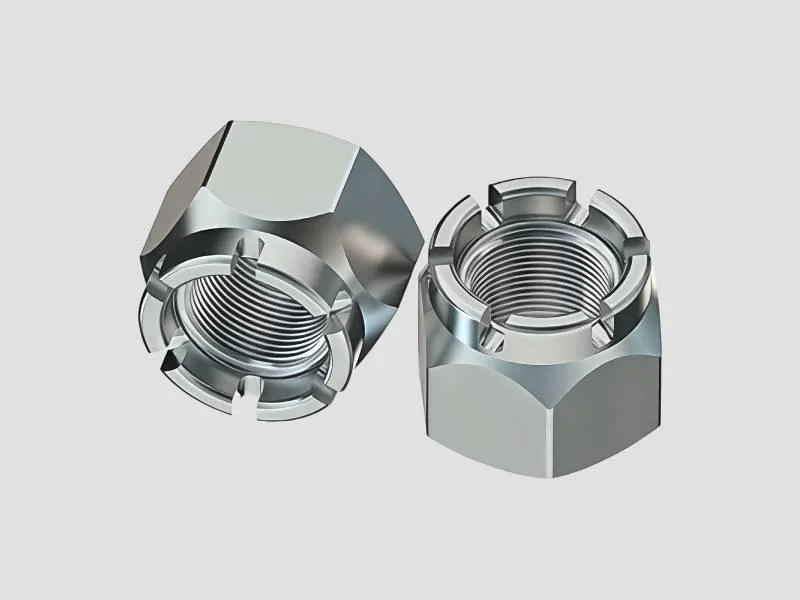
Slotted nuts, often referred to as castle nuts or castellated nuts, are specialized fasteners designed for applications where safety and vibration resistance are critical. Unlike standard hex nuts, they feature precisely machined slots (castellations) on one end. These slots align with a hole drilled through the mating bolt or stud, allowing for the insertion of a cotter pin or safety wire. This creates a simple, yet highly effective, positive mechanical lock that prevents the nut from rotating loose, even under extreme vibration, shock, or dynamic loading. Manufactured to international standards like DIN 935, ISO 7035, and BS 1768, they are available in robust materials including mild steel (often plated for moderate corrosion resistance), stainless steel grades AISI 304 and 316 for excellent corrosion resistance, and brass for specific non-magnetic or decorative needs. With a tensile strength range of 400–800 MPa and hardness of 120–250 HV, they are built to withstand significant str...
Slotted nuts, often referred to as castle nuts or castellated nuts, are specialized fasteners designed for applications where safety and vibration resistance are critical. Unlike standard hex nuts, they feature precisely machined slots (castellations) on one end. These slots align with a hole drilled through the mating bolt or stud, allowing for the insertion of a cotter pin or safety wire. This creates a simple, yet highly effective, positive mechanical lock that prevents the nut from rotating loose, even under extreme vibration, shock, or dynamic loading. Manufactured to international standards like DIN 935, ISO 7035, and BS 1768, they are available in robust materials including mild steel (often plated for moderate corrosion resistance), stainless steel grades AISI 304 and 316 for excellent corrosion resistance, and brass for specific non-magnetic or decorative needs. With a tensile strength range of 400–800 MPa and hardness of 120–250 HV, they are built to withstand significant stress.

These nuts are foundational components in industries that cannot compromise on fastener security. In the automotive and transportation sectors, they are vital for securing wheel bearings, steering linkages, and suspension components, ensuring passenger and vehicle safety. The aerospace industry relies on them for airframe and landing gear assemblies, where failure is not an option. Heavy machinery, agricultural equipment, and construction systems utilize slotted nuts to maintain integrity in joints subjected to constant vibration and high loads. Similarly, railway and marine applications depend on their locking capability to secure components in environments plagued by relentless vibration and harsh conditions, from engine mounts to structural connections.

The business value of sourcing reliable slotted nuts lies in risk mitigation, operational continuity, and compliance. Using fasteners that meet recognized standards ensures compatibility, simplifies procurement, and reduces the risk of assembly errors or premature failures that lead to downtime, safety incidents, and costly repairs. Their proven design offers a cost-effective safety solution compared to more complex locking mechanisms, providing long-term reliability without frequent re-torquing or maintenance. For buyers, this translates into supply chain confidence, reduced liability, and the assurance that the components will perform as specified in the most demanding applications, protecting both equipment and operational reputation.

Key Features:
- Manufactured from high-grade materials: Mild Steel, Stainless Steel (AISI 304/316), and Brass to suit various environmental and strength requirements.
- Complies with international standards including DIN 935, ISO 7035, and BS 1768 for guaranteed dimensional accuracy and interoperability.
- Designed with precision-cut slots (castellations) to perfectly align with a drilled bolt hole for cotter pin or safety wire insertion.
- Offers high mechanical performance with a tensile strength range of 400–800 MPa and a hardness of 120–250 HV for durable fastening.
- Provides excellent corrosion resistance, especially in stainless steel variants, and can operate in temperatures up to 300°C.

Benefits:
- Ensures a fail-safe, positive mechanical lock that prevents nut loosening under severe vibration and dynamic loads, enhancing assembly safety.
- Reduces maintenance needs and inspection frequency due to the permanent nature of the cotter pin lock, saving time and labor costs.
- Offers versatility across industries from automotive to aerospace with standardized sizing and multiple material options for specific applications.
- Improves long-term reliability of machinery and equipment by securing critical joints, thereby minimizing unplanned downtime and repair expenses.
- Delivers a cost-effective and proven locking solution that is simple to install and inspect, ensuring operational integrity and compliance with safety protocols.
Specifications
| Key Attributes | |
|---|---|
| Material | Mild Steel / Stainless Steel (AISI 304 / 316) / Brass, Moderate (MS Plated) |
| Standard | DIN 935 / ISO 7035 / BS 1768 |
| Hardness | 120 – 250 HV |
| Tensile Strength | 400 – 800 MPa |
| Locking Method | Cotter Pin or Safety Wire |
| Operating Temperature | Up to 300°C |
| Corrosion Resistance | Excellent (SS) |
| Additional Information | |
|---|---|
| Country of Origin | India |
Application
Slotted nuts provide essential mechanical locking where vibration, safety, and reliability are non-negotiable. Their design allows a cotter pin or safety wire to pass through the nut slots and a hole in the bolt, creating a positive lock that prevents rotation and loosening under dynamic loads. This makes them indispensable for high-stress, high-vibration environments where standard nuts would fail.
These nuts are engineered for durability across demanding conditions, with materials like stainless steel offering excellent corrosion resistance and operating temperatures up to 300°C. Their standardized dimensions and proven locking method ensure consistent performance and easy integration into existing designs, reducing assembly time and inspection needs while guaranteeing long-term joint integrity.
- Securing wheel bearings, kingpins, and suspension linkages in automotive and heavy vehicle assemblies to prevent catastrophic failure.
- Locking critical structural and control system fasteners in aerospace airframes and landing gear, where safety is paramount.
- Preventing loosening on rotating shafts, high-load joints, and drive systems in industrial machinery and manufacturing equipment.
- Providing reliable fastening for linkages, hitches, and PTO shafts in agricultural tractors and implements exposed to constant vibration.
- Ensuring bolt security in railway bogies, marine engine mounts, and construction scaffolding where vibration and shock are constant challenges.
Trade Details
| Available Stock | In Stock |
| Sample Availability | No |
Payment Terms
| Payment Terms |
|
Company Profile

Chennai Enterprises, Tamil Nadu
 Tamil Nadu, India
Tamil Nadu, India16 yrs
Manufacturer•Retailer
Turn Over
₹25 Lakhs – ₹1 Crore
Factory Details
Factory SizeBelow 1000 sqm
Slotted Castle Nuts DIN 935 ISO 7035 BS 1768 Stainless Steel Brass
Slotted nuts, also called castle nuts, are precision hex nuts with slots for cotter pin or safety wire locking. Available in mild steel, stainless steel (AISI 304/316), and brass, they meet DIN 935, ISO 7035, and BS 1768 standards for secure, vibration-resistant fastening in critical assemblies.
Min. Order Quantity: 1
Shipping
Shipping fee and delivery date to be negotiated. Contact supplier now for more details.
Chennai Enterprises Tamil Nadu, India
Tamil Nadu, IndiaManufacturer