IN
IN₹
Apparel & Fashion
Description
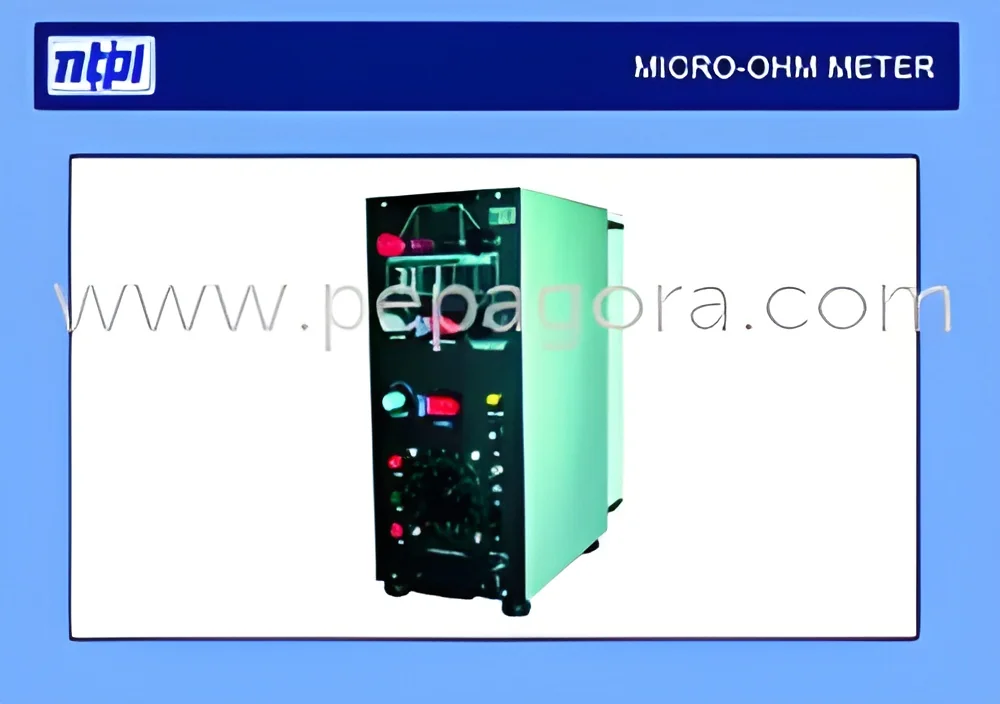
The Industrial Micro Ohm Meter is a precision-engineered instrument designed for the accurate measurement of very low electrical resistance values, critical in industrial and technical environments. Operating on a standard 230V, 1-phase, 50Hz power supply, it features a dedicated measurement range of 0 to 200 milli-ohms (mΩ) with a fine resolution of 0.1 mΩ. This capability is fundamental for assessing the quality of electrical connections, contacts, and conductors where even minor resistance increases can lead to overheating, energy loss, and eventual system failure. The device employs a four-terminal (Kelvin) measurement principle, which nullifies the influence of test lead and contact resistance, guaranteeing that the reading reflects only the resistance of the device under test. This design, combined with ±1% base accuracy, makes it a reliable tool for obtaining trustworthy data in both laboratory calibration settings and on-site industrial testing.

This micro-ohm meter finds exte...
The Industrial Micro Ohm Meter is a precision-engineered instrument designed for the accurate measurement of very low electrical resistance values, critical in industrial and technical environments. Operating on a standard 230V, 1-phase, 50Hz power supply, it features a dedicated measurement range of 0 to 200 milli-ohms (mΩ) with a fine resolution of 0.1 mΩ. This capability is fundamental for assessing the quality of electrical connections, contacts, and conductors where even minor resistance increases can lead to overheating, energy loss, and eventual system failure. The device employs a four-terminal (Kelvin) measurement principle, which nullifies the influence of test lead and contact resistance, guaranteeing that the reading reflects only the resistance of the device under test. This design, combined with ±1% base accuracy, makes it a reliable tool for obtaining trustworthy data in both laboratory calibration settings and on-site industrial testing.

This micro-ohm meter finds extensive application across a spectrum of industries that depend on electrical system reliability and component quality. In the power generation and transmission sector, it is routinely used to test the contact resistance of circuit breakers, disconnectors, and busbar joints within substations, ensuring efficient current flow and preventing hot spots. Electrical equipment manufacturers integrate it into their production lines for quality assurance, testing motor windings, transformer coils, and generator components before assembly. Industrial maintenance teams utilize it as a core part of predictive and preventive maintenance programs, systematically checking connections in machinery, welding sets, and large drives to identify degradation before it causes operational disruption. Furthermore, it serves quality control laboratories and service centers that need to certify components or diagnose faults based on precise resistance benchmarks.

The business value of this micro-ohm meter is rooted in its role as a guardian of operational continuity and asset health. By enabling the early detection of rising resistance in connections and windings, it helps prevent unexpected equipment failures that lead to costly production downtime, safety hazards, and expensive repairs. Its high accuracy ensures that measurements are compliant with international standards (like IEC, IEEE), providing auditable proof of equipment condition for regulatory and warranty purposes. The instrument's robust construction, coupled with protective features for the device and the equipment under test, ensures long-term reliability and reduces total cost of ownership. Investing in such a precise diagnostic tool translates into reduced maintenance costs, extended equipment lifespan, and enhanced overall plant safety and efficiency.

Key Features:
- Four-terminal (Kelvin) measurement method for high-accuracy readings free from lead resistance error.
- Wide selection of test currents (5A, 10A, 20A, 50A, 100A) suitable for testing components of various sizes and materials.
- Precise measurement range of 0-200 mΩ with a fine resolution of 0.1 mΩ for detecting minute changes.
- High accuracy of ±1% ensuring reliable and repeatable results for critical decision-making.
- Flexible operation with both manual and automatic testing modes to suit different user preferences and test protocols.

Benefits:
- Prevents costly downtime and equipment damage by identifying faulty connections and windings early.
- Ensures compliance with industry standards and safety regulations through accurate, verifiable measurements.
- Enhances quality control processes in manufacturing, leading to more reliable end products.
- Supports efficient preventive maintenance programs, extending the operational life of electrical assets.
- Delivers reliable performance in demanding industrial environments due to its robust design and protective features.
Specifications
| Additional Information | |
|---|---|
| Country of Origin | India |
Application
The Industrial Micro Ohm Meter delivers precise low-resistance measurements essential for verifying electrical integrity across critical systems. Its four-terminal measurement method eliminates lead resistance errors, ensuring accurate readings for contact resistance, joint quality, and winding continuity. With selectable test currents from 5A to 100A, it adapts to components from delicate windings to robust busbars, supporting both preventive maintenance and stringent quality assurance protocols.
This instrument is indispensable for industries where electrical reliability is non-negotiable. It provides the diagnostic certainty needed for power generation facilities, electrical equipment manufacturers, and heavy industrial maintenance teams. The ±1% accuracy and 0.1 mΩ resolution enable the detection of minute resistance changes that signal potential failures, allowing for proactive intervention before costly downtime occurs. Its robust design ensures consistent performance in demanding plant environments.
- Measuring contact resistance in circuit breakers, switches, and relay contacts to ensure proper operation.
- Testing the integrity of busbar joints and electrical connections within substations and switchgear.
- Performing quality control checks on transformer windings, motor coils, and generator armatures.
- Verifying the resistance of grounding systems and lightning protection networks for safety compliance.
- Conducting maintenance diagnostics on welding equipment, large motors, and industrial machinery power connections.
Trade Details
| Available Stock | In Stock |
| Sample Availability | No |
Payment Terms
| Payment Terms |
|
Company Profile
Neo Tele-Tronix Pvt Ltd, West Bengal
 West Bengal, India
West Bengal, IndiaManufacturer•Distributor / Wholesaler
Factory Details
Factory SizeBelow 1000 sqm
Annual Production Capacity0
Industrial Micro Ohm Meter 0 200 m Range 0.1 m Resolution
Industrial Micro Ohm Meter with 0-200 mΩ range and 0.1 mΩ resolution for precise low-resistance measurements in electrical testing, maintenance, and quality control applications. Operates on 230V, 1-phase, 50Hz power.
Min. Order Quantity: 1 unit
Shipping
Shipping fee and delivery date to be negotiated. Contact supplier now for more details.
Neo Tele-Tronix Pvt Ltd
 West Bengal, India
West Bengal, IndiaManufacturer